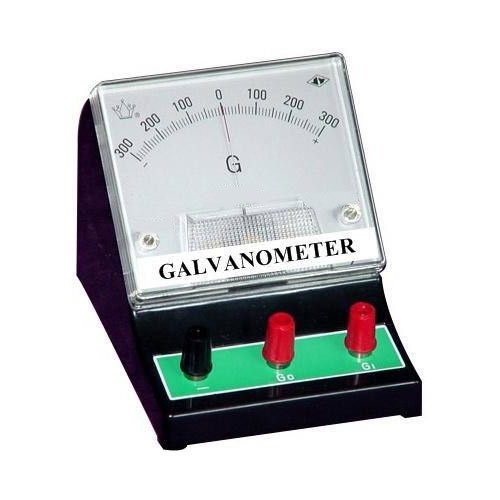

A galvanometer contains components such as permanent horseshoe magnets, a coil, a soft iron core, a pivoted spring, a non-metallic frame, a scale, and a pointer.
Principle of a Galvanometer
A torque acts on a current-carrying coil when it is suspended in a uniform magnetic field.
Because of this, the coil starts to rotate. Therefore, we can say that the deflection of a coil in a moving-coil galvanometer is directly proportional to the current flowing through that coil.
To put it another way, the principle is similar to that of a potentiometer: when a current-carrying coil is placed in a magnetic field, it experiences a torque.
Definition of a Galvanometer
It contains a rectangular coil with many turns of thin insulated copper wire wound on a light metallic frame.
The coil is suspended between the pole pieces of the horseshoe magnet using a fine phosphor-bronze strip, attached to a movable torsion head. The lower end of the coil is connected to a hairspring (also made of phosphor bronze) with only a few turns.
The other end of the spring is connected to a binding screw.
A soft iron cylinder is placed symmetrically inside the coil. These hemispherical magnetic poles create a radial magnetic field in which the plane of the coil remains parallel to the magnetic field in all positions.
A small plane mirror is attached to the suspension wire, which is used along with a lamp and scale arrangement to measure the coil’s deflection.
Main Components of a Galvanometer
The main parts are the moving coil, suspension, torsion head, and a permanent magnet.
- Moving Coil – This is the current-carrying part of the galvanometer. It can be rectangular or circular, with many turns of fine copper wire. The coil moves freely along its vertical axis of symmetry between the poles of a permanent magnet. The iron core provides a low reluctance path for magnetic flux, thus producing a strong magnetic field for the coil to move in.
- Suspension – The coil is suspended by a flat ribbon that carries current to it. The lower suspension also carries current, but its torque effect is negligible. The upper suspension is made of gold or copper in ribbon form. Since the wire has low mechanical strength, galvanometers must be handled carefully without jerks.
- Mirror – The suspension carries a small mirror that reflects a beam of light onto a scale, allowing deflection to be measured.
- Torsion Head – Used to control the coil’s position and adjust the zero setting.
Sensitivity of a Moving-Coil Galvanometer
The sensitivity of a moving-coil galvanometer is defined as the ratio of the change in deflection to the change in current:
Sensitivity = dθ/di
If a galvanometer produces a large deflection for a small current, it is called sensitive.
The galvanometer current equation is:
I = (C / nBA) × θ, so
θ = (nBA / C) × I
Differentiating both sides with respect to I:
dθ/di = (nBA / C)
Sensitivity increases when:
- The number of turns and coil area increase
- Magnetic induction increases
- The couple per unit twist of the suspension fiber decreases
Types of Galvanometers
- Moving-coil
- Suspended-coil
- Tangent galvanometer
- Sine galvanometer
What a Galvanometer Measures
- Detects the direction of current flow in a circuit
- Determines the null point in a circuit (a state when no current flows)
- Measures current
- Measures voltage between two points in a circuit
Advantages of a Galvanometer
- Sensitivity increases as n, B, and A increase, and k decreases
- Eddy currents in the metallic frame help the coil quickly come to rest
Disadvantages of a Galvanometer
- Sensitivity cannot be adjusted as desired
- Overloading can damage the device
Difference Between Galvanometer and Ammeter
- A galvanometer is a mechanical device used to detect the magnitude and direction of current, whereas an ammeter is an electrical device used to measure only the magnitude of current.
- A galvanometer detects current direction; an ammeter measures its magnitude.
- A magnetic field is essential for a galvanometer’s working; an ammeter doesn’t necessarily require it.
- A galvanometer is less accurate than an ammeter.
- A galvanometer is used only for direct current, while an ammeter can measure both DC and AC.
- A galvanometer is more sensitive than an ammeter.
- A galvanometer is mainly used in bridges and potentiometers to detect zero current, whereas an ammeter is directly connected in series to measure current.