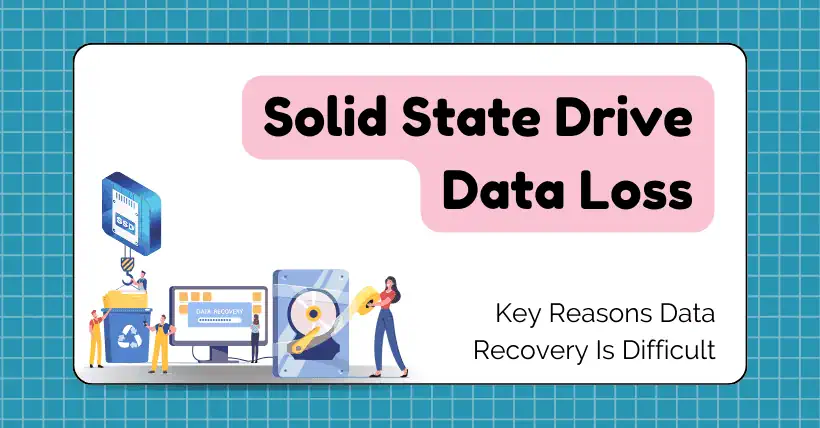

Rising Use of SSDs and the Challenges of Data Recovery
In the last two decades, the field of computer storage technology has witnessed major changes. Among this rapid progress, the tremendous success of Solid State Drives (SSDs) stands out. Compared to hard drives and CDs, SSDs are stronger, smaller, and most importantly, much faster.
SSDs use flash memory chips to store all your data, eliminating the need for complex processes like storing data on spinning magnetic platters. This boosts system speed and performance, but at the same time makes data recovery more difficult. Let’s dive deeper into the fascinating world of SSDs — the reasons behind their success and the challenges they pose for data recovery experts.
Why are SSDs the most preferred storage?
The gradual replacement of HDDs by SSDs is not a coincidence; it’s the result of the need for faster, stronger, and more energy-efficient storage.
- Better performance and speed
The most notable feature of SSDs is their ability to read and write data extremely fast. HDDs face delays due to moving mechanical parts, while SSDs use NAND flash memory, allowing near-instant read/write processes. As a result, SSDs provide up to 100 times faster data access than HDDs. - More durable and reliable
HDDs often suffer from mechanical failures due to moving parts. SSDs, on the other hand, have no moving components, making them more resistant to drops, shocks, or wear and tear. This makes SSDs ideal for portable storage devices and industrial applications where durability is essential. - Lower power consumption and less heat
Unlike HDDs, SSDs don’t require a spindle motor to spin platters, which reduces energy usage. This increases laptop battery life and reduces operating costs in data centers. Less heat generation also improves thermal management in electronic devices. - Compact and portable design
Advances in flash memory technology allow manufacturers to design smaller, portable solutions — from ultra-slim laptops and high-capacity external drives to built-in smartphone storage.
Why is SSD data recovery so challenging?
While SSDs have many advantages, they present some unique challenges for data recovery. Thankfully, leading data recovery companies like Stellar Data Recovery have developed advanced tools and techniques to recover lost data from SSDs.
Key reasons SSD recovery is difficult include:
- Data deletion and TRIM function
Modern SSDs use a TRIM command that clears data blocks quickly. While beneficial for performance, it makes deleted files nearly impossible to recover. In such cases, only expert recovery services can help. - Wear and limited write cycles of flash memory cells
NAND memory cells degrade over time. Each write cycle wears out the oxide layer, eventually making data inaccessible in older SSDs. Specialized techniques are required for recovery in such scenarios. - Controller and firmware dependencies
Data storage on flash chips is managed by an SSD controller. If the controller fails due to overheating, power loss, or firmware corruption, the drive may stop working, blocking access to data. - Data security and encryption
Many SSDs come with built-in encryption for data protection. While this secures information, it complicates recovery — accessing data without encryption keys requires advanced forensic tools.
Why professional recovery services matter
If you suspect your SSD has failed or you can’t access important data, attempting DIY recovery may worsen the situation and lead to permanent data loss. Professional recovery experts are the safest option.
How to choose the best SSD recovery service?
Since SSD data recovery is complex, selecting a reliable and experienced provider is critical. Specialists like Stellar Data Recovery use proprietary tools and advanced technologies to maximize success. They handle all SSD types, including SATA, NVMe, M.2, and PCIe.
Looking ahead: Balancing performance and data security
Today’s SSDs are stronger, faster, and more efficient than ever. But with improved performance come new challenges. Often, increased speed and security reduce the chances of successful data recovery.
That’s why both individuals and businesses must handle critical data with care — adopting reliable backup systems, monitoring SSD health, and seeking expert help when necessary.
![How to Earn Money from Facebook [₹30,000 to ₹40,000] – Learn 10 Easy Ways](https://weplayr.com/wp-content/uploads/2025/08/How-to-Make-Money-on-Facebook-300x200.jpg)